
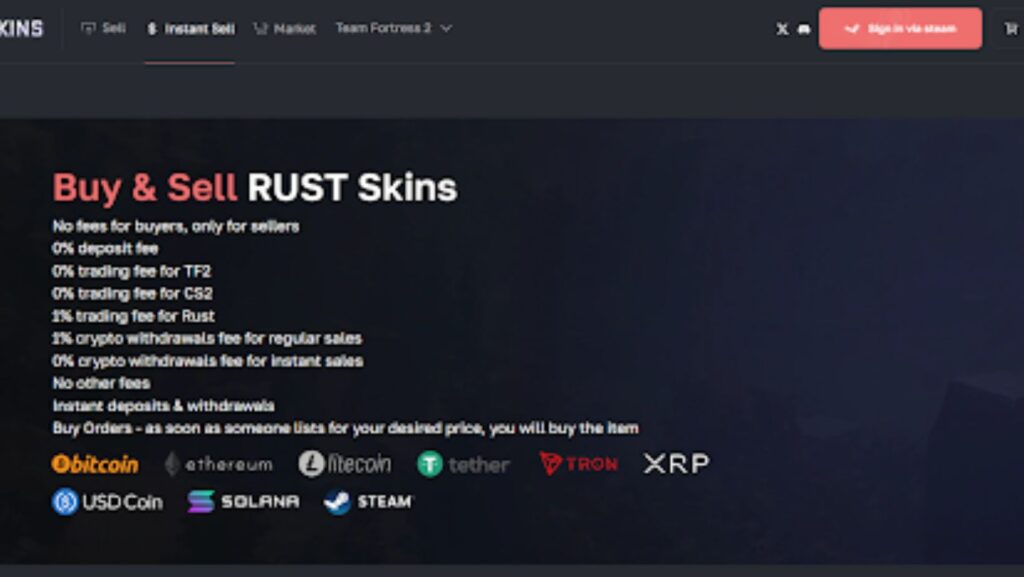
Selling Rust skins for real money is not the same thing as trading skins, swapping them for site balance, or buying other items. The official Rust store does not allow reselling at all, and many third-party platforms are designed mainly to keep value inside their own ecosystem. If your goal is to move value out of the skin economy and into your bank account, card, or payment service, you need to look at a different set of criteria: payout methods, fees, speed, and platform risk.
In 2026, there are three main ways players cash out Rust skins: a large RUST skins market with fiat withdrawals, peer-to-peer platforms with escrow, and instant cashout services that buy your items directly. Each path solves a different problem, and each one costs you something, either time, money, or flexibility.
The right choice depends on whether you care most about maximum payout, safety, or speed.
The Ideal Places To Sell Rust Skins For Real Money
There is no single “best” platform for every seller because the market is built around different priorities. Some players want to squeeze out every possible dollar from their skins. Others want a simple, low-effort process. Others just want cash immediately and don’t care much about the final number as long as it’s fast and guaranteed.
That’s why the ecosystem has split into three main categories: large marketplaces with withdrawals, peer-to-peer platforms with escrow, and instant cashout services. Each one solves a different problem and charges you in a different way, through time, fees, or price discounts.
1. Large Marketplaces With Real-Money Withdrawals
These platforms work like traditional online marketplaces. You list your Rust skins, buyers browse and purchase them, and once the sale is completed, the platform credits your account. From there, you can withdraw your balance to a real payment method such as a bank transfer, card, or supported payment service.
- You connect your Steam account and deposit or list your skins.
- You set a price (often guided by recent sales and current listings).
- Your item appears alongside other sellers’ listings.
- A buyer purchases it.
- The platform confirms the trade and credits your balance.
- You request a withdrawal and wait for it to be processed.
This is the most “traditional” way to sell skins for cash, and it’s the closest thing to a normal online marketplace experience.
- High traffic and steady demand. Big marketplaces attract a lot of buyers every day. More buyers means a higher chance your item sells, and sells at something close to its real market value rather than at a heavy discount.
- Transparent pricing. You can usually see dozens of similar listings and recent sale prices. That makes it easier to judge what your skin is actually worth and avoid selling too cheap.
- Established payout systems. Larger platforms tend to have well-tested withdrawal processes, clear rules, and multiple supported payment methods. That reduces uncertainty about whether and how you’ll get paid.
What you give up
- Time. You’re waiting for a buyer. For popular skins, this can be quick. For niche, expensive, or unpopular items, it can take days or longer.
- Fees. Most platforms charge a seller fee, and many also charge withdrawal or processing fees. These costs come out of your final payout, not the headline sale price.
- Payout delays. Even after a sale, withdrawals often take time to process. Depending on the platform and payment method, this can range from hours to several days.
This approach makes the most sense if you want market-level prices and are willing to accept some waiting and some fees in exchange for a higher final payout.
2. Peer-To-Peer (P2P) Platforms With Escrow
P2P platforms take a different approach. Instead of acting like a shop, the platform connects you directly with a buyer. It provides escrow, dispute handling, and the technical infrastructure to make the trade safer, but it doesn’t usually set prices or hold large inventories.
- You list your skin and set your asking price.
- A buyer agrees to your price or makes an offer.
- The platform locks the item or the money in escrow.
- Both sides complete their part of the trade.
- The escrow is released and you receive payment.
The platform’s role is to reduce risk, not to control the market.
- More pricing control. You decide what your skin is worth. You’re not forced to follow automated market pricing or undercut dozens of similar listings.
- Often lower platform fees. Because these platforms don’t run massive bot inventories or full marketplaces, their overhead is usually lower. That often translates into smaller fees.
- Better for rare or high-value items. If you’re selling something unusual or expensive, you don’t have to compete with a wall of cheap listings. You can wait for a buyer who actually wants that specific item.
What you give up
- Speed. You need to find a buyer who agrees with your price. That can take time, especially if your item is niche or priced aggressively.
- Convenience. There’s more manual involvement. You may need to monitor offers, confirm steps in escrow, and sometimes communicate through the platform.
- More dependence on trust systems. Even with escrow, the quality of dispute resolution and support matters a lot. A weak system here can turn a problem into a long headache.
This approach is ideal if you’re selling valuable, rare, or collectible skins and care more about getting the right price than about selling quickly.
3. Instant Cashout Services
Instant cashout services remove the marketplace entirely. Instead of waiting for a buyer, the platform (or a partner) offers you a fixed price, buys your skin directly, and pays you out as soon as the trade completes.
- You select a skin to sell.
- The platform shows you a guaranteed price.
- You accept the offer.
- You complete the trade with the platform’s bot or system.
- You receive your payout in balance or cash.
There is no listing, no buyer search, and no waiting for market demand.
- Speed. This is the fastest way to turn skins into money. The entire process can take minutes.
- Simplicity. No listings, no price research, no buyer management. It’s a straight exchange.
- Certainty. You know exactly how much you’ll get before you confirm the trade. There’s no risk of your item sitting unsold.
What you give up
- Price. The offer is almost always below normal market value. The platform needs a margin to cover risk and resale time.
- Flexibility. You can’t negotiate, wait for a better buyer, or test higher prices.
- Value on niche items. Slow-moving or unusual skins often get heavily discounted or are rejected entirely.
This is the right choice if you need money right now and are willing to accept a lower payout in exchange for speed, simplicity, and zero friction.
How To Choose A Safe Site To Cash Out Rust Skins
When real money is involved, safety becomes more important than convenience or even price. You’re no longer just swapping items inside a game economy, you’re trusting a third party to sit between your Steam inventory and your real cash. That means you’re exposed to two types of risk at the same time: losing your items and losing your money.

A good platform reduces both. A bad one shifts that risk onto you. To judge the difference, focus on three big pillars: security, reputation, and payout reliability.
1. Steam Authentication And Trade Verification
The first and most basic safety filter is how the site handles Steam login and trades. A legitimate platform should:
- Use official Steam login and redirect you to Steam’s own site or window for authentication. This ensures the platform never sees your password.
- Never ask for your Steam password directly. There is no technical reason for a third-party site to need it.
- Let you verify every trade offer inside Steam before accepting it. You should always see the trade coming from a clearly identifiable bot or counterparty and be able to inspect the items.
This matters because most large-scale skin scams don’t happen through clever hacking. They happen through credential theft and fake trade flows. If a site asks you to enter your Steam login details directly, or tells you to “confirm” trades outside of Steam, you’re giving up the only protection Steam provides.
If a platform:
- Pushes you into private trades
- Asks you to add random accounts manually
- Sends links that mimic Steam pages
- Or tries to rush you past trade verification
…that’s not a minor red flag. That’s a structural risk.
2. Transparent Payout Rules
Once your items are sold, the next question is simple: how do you actually get your money out? A trustworthy platform answers this clearly before you ever list anything. You should be able to see, in plain terms:
- Which payout methods are supported (bank transfer, card, payment services, etc.)
- How long withdrawals usually take under normal conditions
- Minimum and maximum withdrawal limits
- All fees involved in cashing out, including processing and conversion fees
This information should not be hidden in fine print or revealed only at the last step. Why this matters:
- A platform can look great on prices but quietly make withdrawals slow or expensive.
- Some sites encourage you to keep money inside their system by making cashouts inconvenient.
- Others impose minimum withdrawal thresholds that can trap small balances for a long time.
If payout rules are vague, incomplete, or hard to find, you’re setting yourself up for surprises after your items are already gone.
3. Platform History And User Reputation
When you cash out skins, you’re effectively giving a company temporary custody of your assets or your money. That makes their history and reputation more important than flashy design or aggressive marketing.
Platforms that are statistically safer usually:
- Have been around for years, not months
- Have visible user feedback, discussions, or reviews outside their own site
- Maintain active support channels with real responses, not just automated messages
Longevity matters because running a skin marketplace involves legal, technical, and financial overhead. Scams and unreliable sites tend to disappear quickly. Stable platforms survive because they actually process payouts, handle disputes, and keep users coming back.
You’re not just choosing where to sell. You’re choosing who holds your money during the process. That’s a much higher bar than choosing where to buy a skin.
4. Failure And Dispute Handling
Even on good platforms, things go wrong. Steam goes down. Bots bug out. Inventories get locked. Trades fail. What separates a serious platform from a risky one is how these cases are handled. A reliable site explains in advance:
- What happens if a trade fails or times out
- Whether you get your item back or your balance credited
- How disputes are handled and how long resolution usually takes
- What kind of proof or logs are used to resolve conflicts
If a platform doesn’t explain this clearly, then in practice you’re the one carrying the risk. And when real money is involved, that’s not a position you want to be in.
What Affects How Much Money You Actually Receive
The number you see on a listing page is almost never the number that ends up in your bank account. Between platform fees, payment processing costs, currency conversion, withdrawal rules, and speed-related discounts, the gap between the headline price and your real payout can be much larger than people expect.
If you want to make smart decisions when cashing out Rust skins, you have to stop thinking in terms of “what it sells for” and start thinking in terms of what lands in your account.
Three factors dominate that final number: fees, withdrawal methods and limits, and the price you accept for speed.
1. Platform And Transaction Fees
Almost every step in the cashout process can carry a cost. Depending on the platform and payment method, you may encounter:
- Seller or success fees: This is the platform’s cut for facilitating the sale. It’s often a percentage of the sale price. Even a 5–10% fee can wipe out a big chunk of your margin, especially on higher-value items.
- Payment processing fees: These come from the payment provider rather than the marketplace itself. Cards, online wallets, and some regional services charge their own percentage or flat fee, and platforms often pass that cost on to you.
- Currency conversion fees: If the platform operates in a different currency than your bank or card, there’s usually a conversion spread or extra fee. This cost often doesn’t show up clearly on the site, you only see it on your bank statement.
- Withdrawal fees: Some platforms charge a fixed fee or a percentage just to move your balance out of the system. This can be small for large withdrawals and painful for small ones.
Put together, these costs mean that a skin that sells for $100 might realistically leave you with $85–$95, sometimes even less depending on the platform and method you choose. That’s why it’s critical to always calculate your net payout, not just look at the sale price.
A platform with slightly lower prices but cheaper fees can easily beat a platform with higher headline prices and expensive withdrawals.
2. Withdrawal Methods And Limits
How you get paid matters just as much as how much you get paid. Different platforms support different cashout options, such as:
- Bank transfers
- Cards or online payment services
- Region-specific methods depending on where you live
Each of these comes with its own trade-offs:
- Different fees: Some methods are cheap but slow. Others are fast but expensive. Over time, these differences add up, especially if you cash out often.
- Different processing times: One platform might process a card payout in hours and a bank transfer in days. Another might reverse that. If timing matters to you, this is not a small detail.
- Different minimum and maximum limits: Many platforms won’t let you withdraw below a certain amount. Others cap how much you can withdraw at once. That can force you to leave money sitting in the system longer than you want.
If you plan to cash out regularly, these rules can matter more over time than small differences in sale price. A platform that’s slightly worse on pricing but better on withdrawals can be more profitable in the long run simply because less value leaks out in fees and friction.
3. The Speed Discount
If you use instant cashout services, you’re paying a built-in price discount.
This is how that discount usually works in practice:
- Popular, liquid items get smaller discounts: The platform knows it can resell them quickly, so it doesn’t need a big safety margin.
- Niche or slow-moving items get larger discounts: These are risky to hold, so the platform protects itself by offering much less than market value.
- Some items aren’t accepted at all: If the platform thinks an item will be too hard to resell, it simply won’t make an instant offer.
The platform takes on the risk and effort of reselling your item later, and you give up part of the value in exchange for immediate, guaranteed cash. A good mental model is wholesale vs retail:
- Selling on a marketplace is like selling at retail: more work, more waiting, better price.
- Using instant cashout is like selling to a dealer: fast, simple, but cheaper.
More Stories
The Evolution of Digital Security in the iGaming Industry
How Provably Fair Technology Is Rebuilding Trust in iGaming
How to Get a Telegram API Key and Build a Bot Integration