
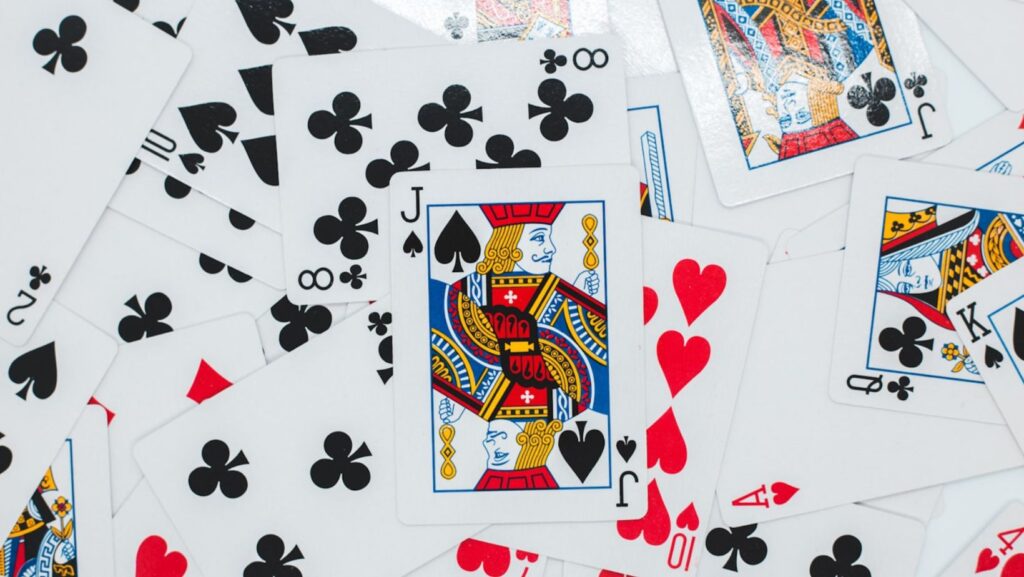
In recent times, digital entertainment has become a phenomenon. Because of this, it’s sometimes easy for us to link entertainment with technology. Video game consoles, mobile phones, social networks… We sometimes forget that a significant part of this offering has much simpler and more rudimentary origins.
It’s not unusual, however, to find a group of friends happily passing the time with just a deck of cards. Playing cards have provided countless moments of enjoyment throughout history. Since when? Well, it’s difficult to pinpoint the exact moment. Even so, we’ll try to shed some light on this in this article.
Where do we start?
Games are as old as humanity. The simplest ones didn’t even require any equipment. However, as materials became easier to shape, objects took on a special significance, symbolizing important elements in the games. Perhaps one of the earliest known games is Başur Höyük, of Turkish origin, which dates back to 5000 BC.
But here’s where the first debate arises. Other experts believe that Mancala already existed earlier (around 6000 BC) and support their theory with remains found in Jordan. Whichever is true, it’s clear that these pastimes played a significant role in civilization. And, moreover, it’s quite possible that there were earlier examples, of which no evidence remains.
Playing cards enter the scene
The use of objects in games continued, of course. Some of them have survived to this day, such as dice or marbles, and are thousands of years old. Chess, too, is estimated to have originated around the 6th century (through its precursor, the Indian game Chaturanga).
But we know we came here today to talk about card games, so it’s time for them to make their grand entrance. How far back do we have to go? Well, again, the answer isn’t simple. As far as we know, they originated in China. And the era (this is a bit more complex) could date back to the 9th century, during the Tang Dynasty.
Interestingly, the first playing cards were called “money cards” and appeared shortly after the creation of paper money. This theory gains strength when we discover that, in the middle of that century, the “Leaf Game” (Yezi Xi) is also mentioned in writings, which could be the first form of entertainment that used playing cards.
Other theories and the arrival in Europe
Given the far-reaching nature of this discovery, it’s no surprise that some controversy surrounds it. The Chinese theory has been joined by others, such as the Persian, Egyptian, and Indian theories. In these cases, one could even argue for greater antiquity. Of course, no evidence has been found to refute the currently most widely accepted version.
What does seem clear is that these nations played a major role in bringing these games (and playing cards themselves) to Europe. Trade routes were the reason. Merchants and workers enjoyed playing cards and taught them to those they interacted with.
This phenomenon is estimated to date back to the 14th century; however, it had already spread throughout much of Asia before then; for this reason, it evolved and acquired elements from different cultures. Furthermore, upon reaching the Old World, they encountered laws that prohibited its practice in various places (or for certain individuals, such as religious figures or knights).
What remains of those games?
We understand that probably none of our readers have played Başur Höyük or Mancala recently. But those who regularly play online blackjack are more likely to recognize the name “Vingt-et-Un.” It’s a precursor, originating in 17th-century France, whose essence has survived to this day.
Although, for longevity, poker takes the cake. Although, of course, with some nuances. Poker, as such, originated in the 19th century and the North American continent; before that, it was known as “Poque” in France. And, even before that, it was “As Nas,” from Persia, whose origins (as far as we know) date back to the 16th century.
There’s no denying that playing cards have come a long way. Of course, they’ve also had plenty of time to do so. We’re talking about one of humanity’s oldest forms of entertainment. And it seems they’re still going strong today.
More Stories
Anjouan Gaming License in 2026: Why It Became the Default Choice for iGaming Startups
Is Game Co-Development Right For You? A 10-Point Checklist for Studios
Micro-Pause Betting: How Split-Second Delays Change Player Decisions