
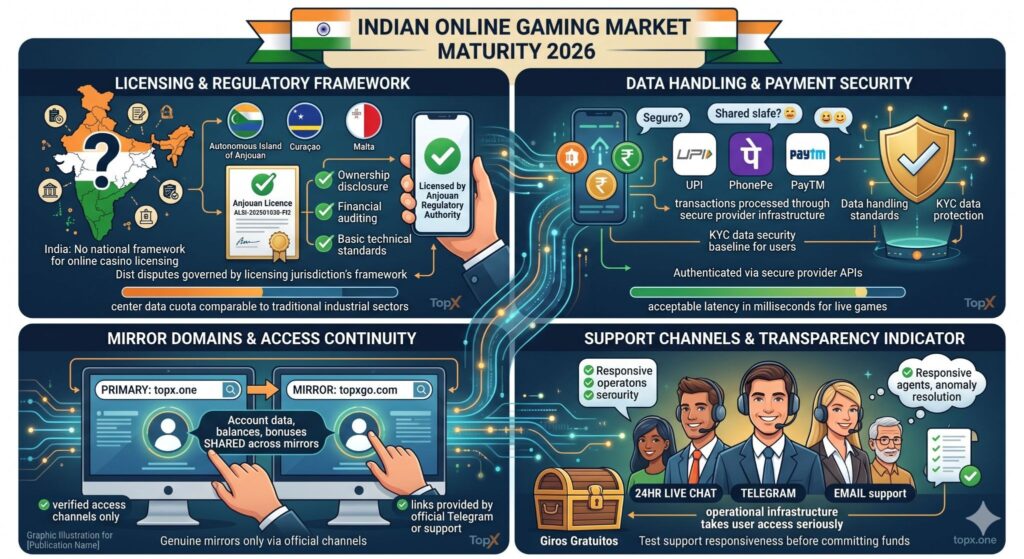
India’s online gaming market has matured fast. A user base that five years ago was still navigating the basics of digital payment is now sophisticated enough to ask harder questions: who operates the platform they are using, under what legal framework it functions, how their personal and financial data is handled, and what recourse exists if something goes wrong. These questions do not always get clear answers, and the gap between what platforms disclose and what users assume is one of the more consequential information asymmetries in India’s digital economy in 2026. Platforms like TopX casino — operated by TopX Limited under licence ALSI-202501030-FI2 issued by the Autonomous Island of Anjouan, with its official site at topx.one and mirror at topxgo.com — represent the class of offshore operators that dominate the Indian market, and understanding how they are structured is the starting point for any informed assessment of platform security.
Licensing and What It Actually Means
The most common misunderstanding among Indian users of offshore gaming platforms concerns the nature and implications of international licences. A licence from Anjouan, Curaçao or Malta does not mean that the platform is regulated under Indian law — India has no dedicated national framework for online casino licensing. What it does mean is that the operator has met the requirements of a specific offshore regulatory authority, which typically includes ownership disclosure, financial auditing and basic technical standards for game fairness.
The practical implication for Indian users is that disputes are governed by the licensing jurisdiction’s framework, not by Indian consumer protection law. This is not unique to gaming platforms — it applies to any internationally licensed digital service operating in a market where domestic regulation has not yet caught up with the product category. Understanding this distinction does not make a licensed platform untrustworthy, but it does clarify what the licence represents and what it does not.
Data Handling and the Payment Layer
The payment layer is where data security is most consequential for Indian users. Transactions through UPI, PhonePe and PayTM — the primary deposit methods for Indian players — involve financial credentials that, if mishandled, carry direct risk. The relevant question is not whether a platform accepts these payment methods, but how the payment flow is architected: whether transactions are processed through the payment provider’s own secure infrastructure or routed through intermediary layers that introduce additional data exposure.
Established payment providers in India — UPI operators, PhonePe, PayTM — enforce security standards at their own infrastructure level. A transaction authenticated through these providers inherits those protections regardless of the platform on the other side of the flow. The risk surface for users is not primarily in the payment execution itself but in account-level data: registration information, KYC documents if verification is required, and communication history with support channels.
Mirror Domains and Access Continuity
A feature of offshore gaming platforms that Indian users frequently encounter but rarely fully understand is the mirror domain — an alternative URL that provides access to the same platform when the primary domain is inaccessible. TopX, for instance, operates topxgo.com as a mirror alongside its primary domain at topx.one. Both addresses connect to the same account infrastructure, meaning balances, bonuses and personal data are shared across them.
From a security perspective, the mirror domain raises a legitimate question: how does a user verify that a mirror URL they encounter is genuine rather than a phishing site mimicking the original? The practical answer is to access mirror domains only through links provided by the platform’s own official channels — the primary website, official support contacts, or verified Telegram channels — rather than through search results or third-party links whose provenance cannot be confirmed.
Support Channels as a Transparency Indicator
One of the more reliable indicators of platform trustworthiness that Indian users can evaluate directly is the quality and accessibility of customer support. A platform that offers 24-hour live chat alongside Telegram and email support — with demonstrably responsive agents — is signalling an operational infrastructure that takes user access seriously. A platform that routes all support through a single slow-response email channel is signalling the opposite.
Support quality also has a practical security function: a responsive support channel is the first line of response when a user encounters an account anomaly, a delayed transaction or a bonus discrepancy. The difference between a problem that gets resolved in minutes and one that takes days — or never gets resolved at all — depends almost entirely on the support infrastructure behind it. For Indian users evaluating platforms in 2026, testing support responsiveness before committing significant funds is a straightforward due diligence step that most skip and few regret doing.
The Informed User Advantage
India’s online gaming market will not wait for regulatory clarity before continuing to grow. In the absence of a domestic framework that provides formal consumer protections, the informed user is effectively their own regulator. Understanding operator structure, reading licence terms, using verified access channels and evaluating support quality are not advanced due diligence — they are baseline habits that the maturity of India’s digital market in 2026 increasingly demands.
More Stories
What the New EU AML Rules Actually Mean for Your Data When You Play Online
Online Privacy and Digital Entertainment: What You Should Know
4 New Online Casinos That Stand Out in a Crowded Market